
SEO and AI Search Rank Tracking for SaaS (2027)

53% of all web traffic comes from organic search (Source: 2027 Stats in this guide). To get a full view in 2027, you also need seo and ai search rank tracking that covers large language models where buyers ask “what should I use?” and read the answer. The short answer: track Google SERP positions and AI citations side by side, review weekly, and tie movement to pipeline. That’s how you find gaps fast and fix what matters.
Here’s the rub. SaaS buyers now blend Google and AI searches across the funnel. They might Google “best CRM for small business”, then ask ChatGPT “compare HubSpot vs Pipedrive for a 10-person team”, then return to Google for pricing pages. If you only track one surface, you miss where the decision was made.
In this guide, I’ll show you the exact framework my team uses. You’ll audit current rankings, map priority LLM questions, watch your brand’s citation footprint, and build a cadence that drives real pipeline, not vanity wins. I’ll point to specific tools and a simple scorecard you can copy. By the end, you’ll have a lightweight system you can run every week without adding headcount.
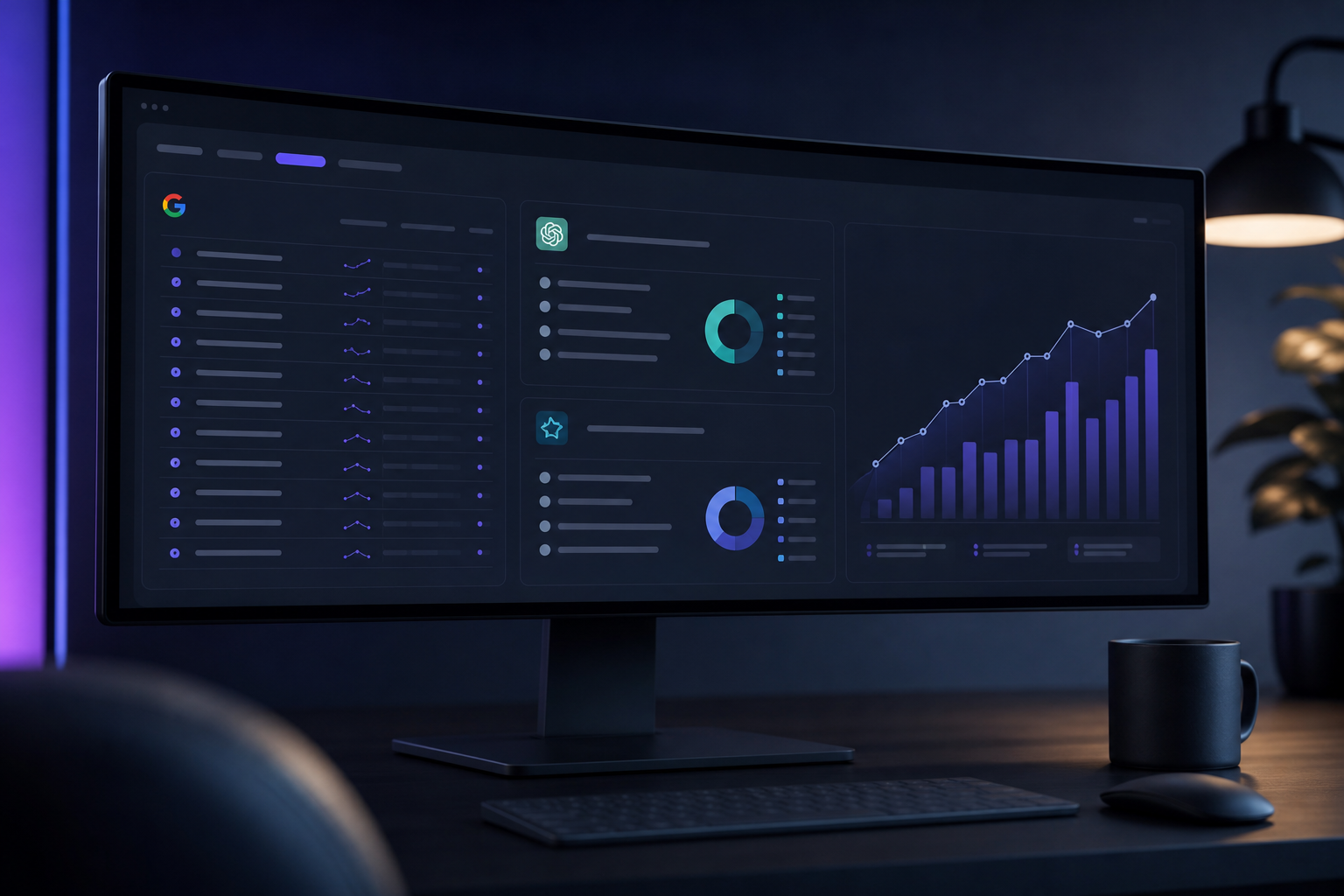
Why SaaS Companies Need to Track Both Google and AI Search Rankings
SaaS buyers split their research. Per the Stats in this guide, 53% of all web traffic comes from organic search, and 15%+ of search now happens inside LLMs. That’s not a rounding error. That’s a second surface where your brand must be seen, named, and trusted.
Moreover, ~70% of AI citations point to a small set of repeat domains. If your site isn’t in that “short list,” your great content won’t get mentioned when a buyer asks an AI for advice. That means fewer brand impressions and fewer mid-funnel clicks.
I’ve watched this play out with head terms like “best CRM for small business.” Google still sends high-intent traffic, but AI answers now shape shortlists and comparisons. If you track SERP rank alone, you’ll celebrate a page-one win while losing mindshare in AI answers. That disconnect shows up later as a softer demo rate.
Therefore, treat visibility as dual-surface: Google positions and AI citations. The goal is clear: show up in both when a buyer searches or asks for guidance. You can do that with a weekly loop: check ranks, check citations, fix gaps, and measure impact on MQL-to-SQL rate.
- Google tells you: which pages win clicks today.
- LLMs tell you: which brands and pages get named in buying moments.
- Together they tell you: where to build or refresh content next.
Step-by-Step Framework for Tracking SEO and AI Rankings
This is the system we run every week. It’s simple, stable, and it scales. Keep it lean and you’ll stick with it. I’ll reference features like GSC integration, Rank Tracking, Visibility Radar, Gap-closure tracking, and a 40-Signal Quality Scorer so you can mirror the setup in your stack.
1) Audit current SERP positions
Start with a clean baseline. Pull your top 200 terms from Google Search Console and your rank tracker. Group by intent: commercial (“best CRM for small business”), transactional (“CRM pricing”), and problem-based (“how to migrate from spreadsheets”). Note where you rank and which URL wins.
- Tag branded vs unbranded terms.
- Mark features and pricing pages separately.
- Capture CTR and impressions so you can track lift.
2) Identify target LLM queries
Next, list the prompts your ICP would ask an AI. Use real language, not keywords. For example: “What’s the easiest CRM for a 10-person sales team?” or “Compare Pipedrive vs HubSpot for outbound.” Map 25–50 prompts per core product line.
- Include “best,” “vs,” and “for [use case]” prompts.
- Add “how to” and “alternatives to [competitor]”.
- Tie each prompt to one owner page and a support post.
3) Monitor AI citation presence
Now, check whether your brand and URLs appear as citations in those LLM answers. Think of this as a “Visibility Radar” across AI channels. Track three fields for each prompt: “Brand named?”, “Our URL cited?”, and “Which domains cited instead?
- If the AI cites listicles only, plan a research-backed guide.
- If it cites competitors’ docs, strengthen your docs’ authority.
- If no citations appear, create a source worth citing.
4) Set up GSC + rank tracking
Wire in GSC integration and Rank Tracking for weekly deltas. You want an automated pull each Monday with positions, CTR, and clicks for your priority cluster. For example, create a segment for the “best CRM for small business” cluster and watch movements as a group.
- Track Top 10, Featured Snippets, and People Also Ask.
- Flag cannibalization when two URLs fight for one query.
- Add annotations when you ship major changes.
For a reference on setup, see Google’s official Search Console docs: Search Console starter guide.
5) Score content quality
Use a simple 40-Signal Quality Scorer to keep standards tight. Score across signals like originality, depth, first-hand data, UX, speed, and E-E-A-T cues. Anything below threshold goes into the refresh queue.
- Require a clear POV and fresh data or examples.
- Check schema, internal links, and media support.
- Add expert quotes and usage shots where relevant.
6) Build a reporting cadence
Finally, build a one-page “Visibility Report” you can scan in five minutes. Include: SERP gains/losses, LLM citation changes, content shipped, and pipeline impact. Use Gap-closure tracking to show how each action closed a visibility gap.
- Include a single “Next 3 Moves” list.
- Roll up branded vs unbranded visibility.
- Tie everything to opps created and influenced revenue.

Also Read!
Digital Marketing Buddy vs Semrush for SaaS Companies: Which Is Better for SEO and AI Rank Tracking?
How to Choose the Best AI SEO Content Writer for Your Small Business
Common Mistakes SaaS Teams Make with Rank Tracking
I’ve made each of these at least once. Fixing them added pipeline without adding budget.
First, tracking vanity keywords only. It feels good to rank for “CRM” until you learn those clicks don’t convert. Focus on slices where you can win and where your ICP lives: “best CRM for small business” beats generic any day. Segment by intent and business value.
Second, ignoring LLM visibility. Per the Stats here, 15%+ of search now happens inside LLMs. If your brand is not named or cited, you lose ground before the click. Track citations for your shortlist prompts and build sources AIs want to cite.
Third, not segmenting branded vs unbranded. Blended reporting hides real movement. Your “growth” might be branded expansion, not net-new demand. Split them. You’ll make better calls on content and budget.
Fourth, checking rankings manually instead of automating. Manual checks drift. Automate rank pulls and AI citation checks so you spot changes fast. Your Monday report should be ready when you open your laptop.
Fifth, treating SEO and GEO as separate. Generative Engine Optimization (GEO) is not a side quest. It’s the same work seen through a new lens. One plan, one calendar, one report. The same content can and should serve both surfaces when done right.
- $9k/mo average SEO retainer, and most agencies still ignore GEO (Source: 2027 Stats in this guide).
- Combines SEO and GEO in one platform is the right model; the work belongs together.
- Pair your SERP plan with an AI citation plan for the same clusters.
“Stop chasing trophy terms and start owning the questions your buyers ask in AI and Google.” — Advice I give every new PMM
If you run client work, this deep dive helps: SEO and AI rank tracker for marketing agencies. And for lean teams, see: SEO and AI rank tracker for small businesses.
Also Read!
Best AI Content Quality Checker for Small Businesses in 2026
Best AI Search Visibility Tracker for Small Businesses in 2026
Tools for Tracking SEO and AI Search Visibility
Here’s a neutral layout of tools and how they fit in a unified view.
Start with Google Search Console (free). It’s your baseline for queries, clicks, and CTR. Pair it with a traditional SERP tracker for daily positions and features like snippets and PAA. Tools like Ahrefs and Semrush cover that layer well for keyword-level tracking.
Add an LLM monitoring layer for citations. Otterly and Peec are built for AI answer tracking. They scan prompts across major assistants and record whether your brand and URLs appear in the answer or in citations, plus which domains beat you.
For a single-pane view, some platforms now combine both. Tools like Digital Marketing Buddy combine SEO and GEO in one platform, track visibility across Google and LLMs, and include Brand Radar and Visibility Radar for buyer-moment monitoring. It also offers GSC integration, Rank Tracking, a 40-signal quality scoring system, SERP-grounded keyword research, Custom analytics views, and no long-term contracts. Social proof highlights include “AI citations / mo: 2,140+184%” and “Cut content cost by 70%” (Source: platform Stats, 2027). Pricing is per domain with tiers from $200/domain/mo to $600/domain/mo, plus enterprise.
What should you look for in a unified tracker?
- Side-by-side Google rank and AI citation views for the same cluster.
- Gap-closure tracking that ties actions to visibility moves.
- Branded vs unbranded segmentation at the dashboard level.
- Support for owner pages and support posts in one cluster view.
If content production is your bottleneck, this comparison is helpful: AI SEO content writer for ecommerce.

What to Do Next: Building Your SaaS Rank Tracking Stack
Start light and layer up. You don’t need a big migration to get real signal in a week.
First, wire up GSC and build two views: branded and unbranded. Then set up SERP-grounded keyword research for one money cluster, such as “best CRM for small business.” Add daily rank tracking for those terms so you can see micro-moves.
Second, add an LLM monitoring layer. Take 25 prompts your ICP would ask. Check if your brand is named and whether your URLs show up as citations. Record the domains that do get cited. That’s your “who to out-teach” list.
Third, create a weekly 30-minute review. Scan ranks, scan citations, log gaps, and pick three fixes. For example, refresh the owner page with first-hand screenshots, publish a data-backed comparison, and update schema. Keep score in a single doc.
Fourth, tie visibility to pipeline. Build Custom analytics views that tag traffic from your tracked clusters. Watch MQL-to-SQL and demo rate for those paths. As a result, your team will rally around real impact, not traffic for traffic’s sake.
Finally, iterate. Your goal isn’t a perfect map. It’s a steady loop that finds and closes gaps. You’ll see compounding gains in both Google and LLM surfaces when you improve the quality of sources AIs love to cite and humans love to read. That’s the flywheel.
Key Takeaways
Before you roll this out, anchor on a few truths that keep teams focused and calm under pressure.
First, visibility is dual-surface now. Buyers split time between Google and AI assistants. If you don’t track both, you miss where shortlists form. That’s the root cause of “we rank but demos are flat.
Second, a lean loop beats a complex stack. A weekly check on ranks and citations, a simple scorecard, and three focused actions will beat a bloated dashboard every time. Keep your system short and boring so it runs without you.
Third, clusters create clarity. Choose a money cluster like “best CRM for small business,” assign one owner page, and build support posts that add first-hand depth. Clusters make it easy to see gaps and wins across both SERP and AI views.
Fourth, quality wins citations. AIs cite clear, sourced, and useful pages. Your 40-signal quality pass should catch thin claims, stale screenshots, and missing data. Fix those, and you’ll see more brand mentions and better SERP CTR.
- Track Google ranks and AI citations together for the same queries and prompts.
- Split branded vs unbranded to avoid false wins.
- Use SERP-grounded keyword research and a weekly reporting cadence.
- Tie visibility to pipeline, not just traffic, to earn budget and trust.
What to Do This Week
Make this real with a five-day sprint. Keep each task under an hour so it fits around your day job.
- Monday: Pull your top 200 queries from GSC. Tag branded vs unbranded. Shortlist one money cluster with buying intent.
- Tuesday: Write 25 buyer prompts for that cluster. Check AI answers for brand mentions and citations. Log which domains get cited.
- Wednesday: Set up rank tracking for the cluster. Create a one-page report with SERP and LLM sections. Add annotations for ships.
- Thursday: Run a 40-signal quality pass on the owner page. Add first-hand data, fresh screenshots, internal links, and schema.
- Friday: Pick three gap-closure actions for next week. Share the report with Sales. Add pipeline tags for the cluster in your CRM.
Repeat next week. As you see wins, roll the system to your next cluster. By Q1 2027, you’ll have a clear picture of both surfaces and a track record of impact. Your team will know which content to ship, which prompts to pursue, and which gaps to close next.

digitalmarketingbuddy
AuthorGrowth marketing lead and SEO strategist specializing in generative search algorithms and multi-channel attribution.