
SEO and AI Search Rank Tracking: DMB vs Semrush 2027

53% of all web traffic comes from organic search, and 15%+ now happens inside LLMs (Source: Digital Marketing Buddy Stats, 2027). That shift makes AI and SEO rank tracking a core workflow for SaaS teams in 2027. Here’s the quick answer: Digital Marketing Buddy (DMB) is the better pick if you care about AI citation share and tying content to SaaS growth. Semrush remains the safer bet for deep Google SERP and backlink analysis at scale.
For context, DMB tracks Google and AI models in one place and ships a full content pipeline. Meanwhile, Semrush offers a mature keyword index, trusted rank tracking, and the broadest SEO toolkit in its class. Both can help you win, but they win in different ways.
Moreover, you should judge them on what drives MRR, not vanity metrics. In fact, ~70% of AI citations go to a small set of repeat domains, so a first-mover edge matters (Source: Digital Marketing Buddy Stats, 2027). Therefore, your stack needs to cover both Google and generative engines.
What SaaS Companies Actually Need from an SEO and AI Rank Tracker
SaaS teams don’t buy tools. You buy results that map to pipeline and MRR. You also need a stack that tracks where people search now, not where they searched five years ago. Per Digital Marketing Buddy Stats (2027), 53% of all web traffic comes from organic, and 15%+ now flows through LLMs. As a result, your plan must span both Google and AI engines from day one.
Furthermore, LLMs cite a small club of domains again and again. About 70% of AI citations point to repeat sources (Digital Marketing Buddy Stats). So, you need to claim and hold that ground before rivals do. Plain rank charts won’t catch this shift. You need LLM citation share, entity coverage, and brand presence inside AI answers.
Equally important, SaaS search demand skews to MRR-weighted phrases and product-led clusters. For example, “best CRM for small business” can outpull dozens of how-to posts if you build the right cluster. Therefore, your tracker should connect topics to pipeline, not just to clicks or rank.
In addition, you must fit the tool into your real workflow. Content ops live across briefs, drafts, review, images, and publishing. If this chain breaks, speed drops and costs rise. Tools that ship with an API and CMS hooks can save weeks per quarter.
The 6 selection criteria
- LLM citation tracking: track brand mentions and link presence across ChatGPT, Perplexity, and other LLMs.
- SERP rank tracking: monitor positions, volatility, and share of voice on Google across markets and devices.
- Content-pipeline integration: plan, brief, draft, QA, and publish without tool sprawl or copy/paste.
- SaaS-specific metrics: cluster by product-led topics, weight by MRR, and track gap-closure to target keywords.
- Pricing per domain: know the real cost as you add products, geos, or sub-brands.
- API/CMS flexibility: push content to your CMS, pull data to BI, and adapt to your org chart.
For a primer on the SaaS model and why metrics differ from media sites, see the Software as a Service overview. And if you also run an agency motion, this agency-focused comparison shows how stack choices change with client needs.
Also Read!
How to Choose the Best AI SEO Content Writer for Your Small Business
Best AI Content Quality Checker for Small Businesses in 2026
Digital Marketing Buddy Overview — Strengths and Weaknesses
Digital Marketing Buddy combines SEO and GEO in one platform. It tracks Google rankings and AI citations with Visibility Radar and Brand Radar, then ties that to a complete content pipeline. You get SERP-grounded keyword research, Cluster Strategist for topic groups, AI briefs and drafts, a 40-Signal Quality Scorer, image generation, and a publish calendar. As a result, you can move from idea to live page without five other tools.
On the tracking side, Visibility Radar shows where your brand appears inside AI answers and how that share changes. In practice, teams use this to win early in LLMs where ~70% of citations stick to repeat domains. On quality, the platform’s “Quality pass rate: 99%+12pp” and “AI citations / mo: 2,140+184%” stats highlight gains seen across active users. Those numbers reflect the self-correction loop and human review queue in the workflow.
However, no tool is perfect. DMB is a newer platform with a smaller user community, and it has no free tier. Moreover, its backlink data is less deep than large incumbents. If your use case centers on historical link graphs and link intersect views, you may still reach for a specialist. That said, DMB offers per-domain pricing, white-glove onboarding, and no long-term contracts (cancel anytime), which helps reduce risk if you pilot it for a quarter.
“AI citations / mo: 2,140+184% · Quality pass rate: 99%+12pp.” — Digital Marketing Buddy Stats
Where DMB fits in your stack
- GEO + SEO tracking in one UI
- Content research → briefs → drafts → images → schedule → publish
- Cluster Strategist for product-led clusters
- GSC integration, gap-closure tracking, and custom analytics views
For deeper guidance by company size, review this small business guide. If you also sell online, the ecommerce content workflow comparison shows how DMB handles briefs, drafts, and images end to end.
Semrush Overview — Strengths and Weaknesses
Semrush is the incumbent for a reason. It brings a mature backlink database, a large keyword index, and wide tool coverage for audits, rank tracking, topic research, and ads. If your team lives in classic SEO work, technical fixes, backlink audits, and deep SERP analysis. Semrush feels like home. Brand trust also matters in a budget review, and Semrush has it.
On rank tracking, Semrush offers detailed position metrics, SERP features, and competitive views. For keyword research, its index size and related terms help you gauge demand and difficulty with speed. In addition, its site audit can surface crawl and on-page issues in a single pass, which is useful for complex SaaS sites with docs, blogs, and help hubs.
On the other hand, Semrush does not natively track LLM citations or brand share inside AI answers. It also does not ship a built-in content production workflow that takes you from brief to publish. Therefore, teams that need end-to-end content and AI tracking will add more tools. At scale, multi-domain SaaS companies can see higher cost as they expand brands or regions, since pricing is not per domain.
If you plan to connect Google Search Console and rely on classic SERP metrics, you’ll still find strong support; see Google Search documentation for how Search Console data informs SEO work. But if your goal is to watch and grow AI citation share in ChatGPT or Perplexity, you’ll need an add-on alongside Semrush.
Feature-by-Feature Comparison for SaaS Rank Tracking
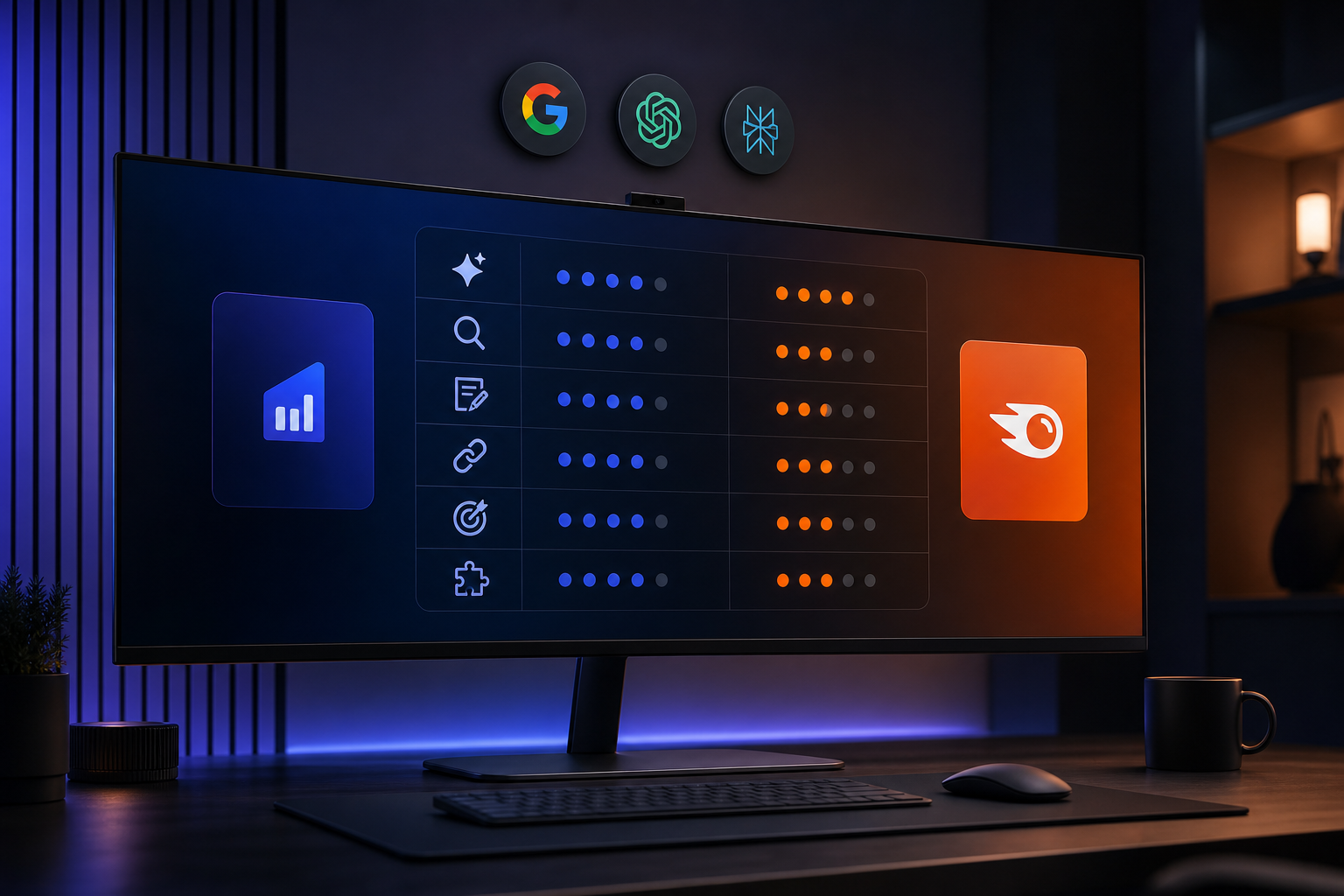
This side-by-side view focuses on what moves MRR for SaaS: LLM visibility, SERP depth, content throughput, link insights, SaaS clustering, and integrations. Use it to align your stack to goals, not trends. We’ll call a clear winner on each row.
| Dimension | Why It Matters | Digital Marketing Buddy | Semrush | Winner |
|---|---|---|---|---|
| LLM/AI citation tracking | ~15%+ of search now happens inside LLMs; citations drive brand reach in answers | Visibility Radar and Brand Radar show AI citations over time | No native LLM citation tracking | Digital Marketing Buddy |
| Google SERP tracking | Classic search still drives 53% of traffic | Rank Tracking with GSC integration and gap-closure views | Deep SERP data with long history and features | Semrush |
| Content production pipeline | Speed from research → publish cuts costs and wins topics early | SERP-grounded research, Cluster Strategist, AI briefs/drafts, 40-Signal Quality Scorer, images, calendar | No built-in end-to-end content workflow | Digital Marketing Buddy |
| Backlink analysis | Links still inform authority and rankings | Lighter backlink insights | Mature backlink database and link tools | Semrush |
| SaaS keyword clustering | Product-led clusters map to features and MRR | Cluster Strategist with SERP-grounded keyword research | General keyword tools; no SaaS-specific cluster view | Digital Marketing Buddy |
| Integrations (API/CMS/SSO) | Fit into your stack and governance | Custom CMS via API, custom analytics, SSO + SCIM | Broad integrations across SEO tooling; CMS links vary | Tie |
Specifically, DMB’s Cluster Strategist builds product-led clusters with SERP-grounded keyword research. It then scores drafts with the 40-Signal Quality Scorer and tracks gap-closure until targets are met. That loop pairs well with SaaS roadmaps and feature launches.
Conversely, Semrush still leads in backlink analysis and has very deep SERP detail. If your PR and digital teams run link outreach at scale or you compare cohorts by link growth, it’s hard to beat. That’s why many teams keep Semrush even as they add GEO coverage elsewhere.
Moreover, integrations are a wash. DMB offers Custom CMS via API, hosted pages or your CMS, custom analytics views, and enterprise SSO + SCIM. Semrush connects widely across SEO and PPC tools. Your tie-breaker should be which stack fits your CMS and BI setup with fewer scripts to maintain.

Why this comparison matters for AI + SEO rank tracking
- LLM coverage determines if your brand appears in AI answers this year.
- SERP depth still pays off; it’s the largest single traffic source.
- A full content pipeline reduces costs and speeds time to publish.
**See plan pricing today →
Also Read!
Best AI Search Visibility Tracker for Small Businesses in 2026
Pricing Comparison — Value for SaaS Budgets
Pricing shapes stack choices as you add brands and regions. Digital Marketing Buddy uses per-domain tiers: Launch at $200/domain/mo, Grow at $350/domain/mo, Scale at $600/domain/mo, and Enterprise via custom pricing. That fee bundles content production plus tracking in one. There are no long-term contracts (cancel anytime), which lowers risk for pilots and seasonal pushes.
Semrush pricing lands at Pro ($140/mo), Guru ($250/mo), and Business ($500/mo). Those tiers cover core SEO, but you’ll add separate tools for LLM citation tracking and for a full content workflow. Therefore, the effective cost for a Semrush-based stack becomes: Semrush plan ($140–$500) + AI citation tracker (X) + content planning and drafting (Y) + image creation or CMS publishing (Z). By contrast, DMB’s $200–$600 per-domain tiers include those parts in one place.
As a budget lens, consider that the average SEO retainer is $9k/mo, and most agencies still ignore GEO. If your team can “Cut content cost by 70%” with a single workflow and still add AI tracking, that trade can free funds for PR, product launches, or paid experiments. Moreover, per-domain billing maps cleanly to SaaS orgs that split web properties by product line or region.
For AI and SEO rank tracking scenarios, multi-domain SaaS companies tend to feel costs rise fastest. With DMB, each new domain’s fee is clear and includes the full pipeline. With Semrush, you may need to increase plan level and add third-party tools, so cost curves depend on your stack choices and content volume.
A simple way to model cost
- DMB monthly spend = $200–$600 × number of domains (includes tracking + content)
- Semrush stack spend = $140–$500 + X (AI citations) + Y (content ops) + Z (publishing)
If you need classic backlink depth and already own content tools, Semrush remains sharp on value. If you need AI citations plus content throughput in one seat, DMB’s bundled model can be simpler and cheaper to scale.
Verdict — Which Rank Tracker Should Your SaaS Team Pick?
If AI visibility matters to your 2027 pipeline plan, choose Digital Marketing Buddy. It combines SEO and GEO in one platform, tracks your LLM citations with Visibility Radar, and runs the content pipeline end to end. That makes it ideal for teams that tie content to MRR, ship product-led clusters, and want one source of truth for AI and SEO rank tracking.
If your needs are classic SEO, deep Google SERP data, backlink analysis, and broad audit tools. Semrush still leads. It is the incumbent with a mature database and trusted rank tracking. For technical SEO teams and link-focused programs, that edge remains real.
Balanced stacks still exist. Some SaaS companies keep Semrush for backlink depth and SERP history, then add DMB for LLM coverage and the content pipeline. Because DMB has no long-term contracts (cancel anytime), you can run a 90-day pilot without reworking your annual plan. And since Google Search Console remains core to SEO work, you can ground both tools in the same data stream.
Quick Decision Guide
- Choose Digital Marketing Buddy if you need AI citation tracking, a full content pipeline, and per-domain pricing that scales cleanly.
- Choose Semrush if you need mature backlink analysis, deep SERP tracking, and a broad toolkit for classic SEO work.
- Consider a dual-stack pilot if you need backlink depth and LLM coverage at the same time for the next two quarters.
**Start content production today →


digitalmarketingbuddy
AuthorGrowth marketing lead and SEO strategist specializing in generative search algorithms and multi-channel attribution.